 Written by: Spec. Dr. Tuba Çelebi Kayhan, Dermatologist
Published:
Short answer
A chemical peel is a treatment in which chemical agents make the skin peel in a controlled way down to a chosen layer, which smoother new skin then replaces. It is used for fine wrinkles, dullness, pigmentation, acne and acne scars; depth depends on the acid and its strength. In Denizli, peels are done by Spec. Dr. Tuba Çelebi Kayhan.
At a glance
| Agents used | AHAs, salicylic acid, Jessner's solution, TCA |
|---|---|
| Depth options | Superficial, medium, deep |
| Time the solution stays on | 1 to 5 minutes |
| Recommended season | The winter months, when the sun is weaker |
The aim of a chemical peel is to create a planned injury down to a particular layer of the skin, and then to make use of the repair process that follows. As the skin renews itself, the pigmented, rough or worn surface layer is replaced by healthier skin. No laser or device is used; the effect is decided by the type and strength of the acid.
How Are Chemical Peels Classified by Depth?
Peels fall into three groups, according to how far the solution works into the skin, the injury it creates and how strong its effect is.
Superficial Peel
It acts only on the uppermost layer of the skin. It is used for dullness, mild pigmentation, oiliness and a tendency to acne. Peeling is light and does not affect daily life; the effect builds as the sessions are repeated.
Medium-Depth Peel
It goes below the upper layer of the skin. It is chosen for more marked pigmentation, fine wrinkles and superficial acne scars. Clear peeling and redness lasting a few days should be expected.
Deep Peel
It is used for deeper wrinkles and scars. The healing time is long and the risk of colour change is higher; for this reason, patient selection and preparation are carried out with great care.
Which Acids Are Used in a Chemical Peel?
- Alpha hydroxy acids (AHAs): fruit-derived acids such as glycolic acid, used as superficial peels for dullness and fine lines.
- Salicylic acid: dissolves in oil and works its way into the pores. It is preferred for oily and acne-prone skin.
- Jessner's solution: a mixture of several acids, applied on its own or as preparation before another peel.
- Trichloroacetic acid (TCA): depending on its strength, it acts at a superficial or medium depth; it is used to treat pigmentation and scars.
Which Skin Problems Is a Chemical Peel Chosen For?
- Fine wrinkles
- Dull skin and uneven tone
- Pigment spots
- Acne
- Acne scars and enlarged pores
For pigmentation, a peel can be part of a programme planned alongside creams and laser; we choose the method suited to your type of pigmentation during the pigmentation treatment assessment. For deep, pitted acne scars, however, the effect of a peel is limited, and methods that stimulate collagen deep in the skin, such as Dermapen microneedling, may be more suitable.
How Is a Chemical Peel Session Done?
- The skin is cleansed of make-up and oil.
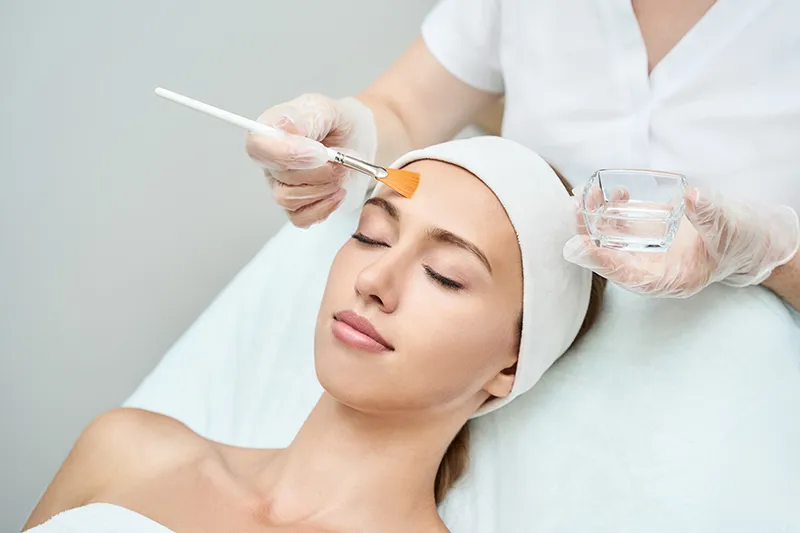
- The chosen solution is brushed onto the face in an even layer.
- Depending on the properties and strength of the solution, it is left on for 1 to 5 minutes.
- When the time is up, the skin is cleansed with a neutralising solution.
- A soothing cream and sunscreen are applied.
Depending on how strong the peel is, you may feel mild stinging, burning and sensitivity during treatment. This feeling eases quickly once the solution has been neutralised.
How Does the Skin Heal After a Peel?
In the first days the skin feels tight and is slightly red, and then peeling begins. After deep peels the peeling can be heavy; during this period you need to apply moisturiser often throughout the day. It is important not to pull off the peeling skin by hand, as this can lead to a scar or a pigment spot.
Until the skin has fully renewed itself, we ask you to pause acid products and abrasive care such as exfoliating mitts and scrubs. After superficial peels you can usually return to make-up within a short time.
Why Is Sun Protection So Important After a Peel?
Newly formed skin is very sensitive to the sun's ultraviolet rays. Going out in the sun during this period can bring treated pigmentation back and even cause new spots. This is why we recommend having chemical peels in the winter months. Whatever the season, you need to use a broad-spectrum sunscreen every day during and after your course of peels.
Who Should Not Have a Chemical Peel?
- People with active cold sores, infection or an open wound in the treatment area
- People who have recently had isotretinoin treatment
- Recently tanned or sunburnt skin
- Pregnancy and breastfeeding (some acids are not used during this time)
- People who tend to form keloids
On darker skin, medium and deep peels carry a risk of leaving pigment marks, so we prefer more superficial and controlled treatments. For the carbon peel, a laser-based renewal option, see Q-switched laser treatments.
Chemical Peels in Denizli: Your Skin Assessment
Before a peel at our clinic in Denizli, we assess your skin type, the depth of the problem, the products you use and how much sun you get. We choose the type of acid, its strength and the interval between sessions based on this information. To talk through your peel plan with Spec. Dr. Tuba Çelebi Kayhan, you can call our clinic.
Frequently asked questions
Does a chemical peel thin the skin?
How many days does peeling last after a chemical peel?
Can I have a chemical peel in the summer?
Is a chemical peel the same as a carbon peel?
Can sensitive skin have a peel?
How should I prepare for a chemical peel in Denizli?
Sources
- Chemical peels — DermNet
- Chemical peels: FAQs — American Academy of Dermatology
This page is for general information only and does not replace an examination, diagnosis or treatment. Please consult your doctor for advice about your own situation.