 Written by: Spec. Dr. Tuba Çelebi Kayhan, Dermatologist
Published:

Short answer
A Q-switched laser delivers its energy in very short, powerful pulses lasting nanoseconds. Each pulse is so brief that the targeted pigment shatters before heat spreads to nearby tissue. In dermatology it is used for tattoo removal, some brown spots, carbon peels and lightening fine, pale hair. In Denizli, the Q-switched laser is used by Spec. Dr. Tuba Çelebi Kayhan.
At a glance
| Pulse duration | In the nanosecond range |
|---|---|
| What it breaks up | Tattoo ink and skin pigment |
| Tattoo removal plan | 6 to 8 weeks apart, usually 4 to 10 sessions |
| Carbon peel plan | 5 to 10 sessions, 7 to 14 days apart |
At our clinic we use Helios II, a Q-switched Nd:YAG laser. The device also has a fractional handpiece, which spreads the energy across the skin in tiny dots and is used for skin rejuvenation. With the same device we can treat tattoos and pigment spots, lighten fine hair and carry out carbon peels.
How Is a Q-Switched Laser Different from Other Lasers?
Most lasers deliver their energy over longer periods and work by heating the tissue. A Q-switched laser concentrates its energy into pulses lasting a billionth of a second. Under this sudden burst of energy, the pigment particle breaks into small fragments before it has time to heat up.
Because the heat does not spread, treatment can be selective, aimed only at the target tissue. The fragmented ink and pigment are then gradually cleared away by the body's scavenger cells.
What Is a Q-Switched Laser Used For?
- Removing tattoos and permanent make-up
- Sun spots, age spots, freckles and light brown café-au-lait macules
- Deep-lying birthmarks such as naevus of Ota, naevus of Ito and Mongolian spots
- Carbon peels for oily skin, acne and enlarged pores
- Lightening fine, pale hair
- Skin rejuvenation with the fractional handpiece
- Supporting the treatment of nail fungus
How Does Laser Tattoo Removal Work?
The laser light is absorbed by the ink that gives the tattoo its colour, and the ink particles are broken into smaller pieces. Over the following weeks these fragments are carried away by the lymphatic system. Because this clearance takes time, we wait 6 to 8 weeks between sessions; the tattoo fades a little more with each one.
When needed, we give a local anaesthetic to the area before treatment. Afterwards there may be swelling, redness and a burning feeling; a thin crust or small blisters can also appear. During this time you need to keep the area clean, leave the crusts alone and protect the skin from the sun.
Which Tattoos Are Harder to Remove?
Black and dark tattoos respond better to the laser. Purple, green and yellow are the hardest colours to remove. Tattoos on the hands, feet and lower legs can also be more resistant to treatment.
In professional tattoos the ink sits deeper in the skin but at levels close to one another, so removal tends to progress more evenly. Where the ink is very dense or has been layered, more sessions are needed.
How Is a Carbon Peel Done?
A carbon peel is a skin rejuvenation treatment carried out with the Q-switched Nd:YAG laser. The face is first cleansed and a thin carbon solution is applied to the skin. After the solution has been left on for about 10 minutes, the laser pulses begin; the laser shatters the carbon particles and lifts them away from the skin.
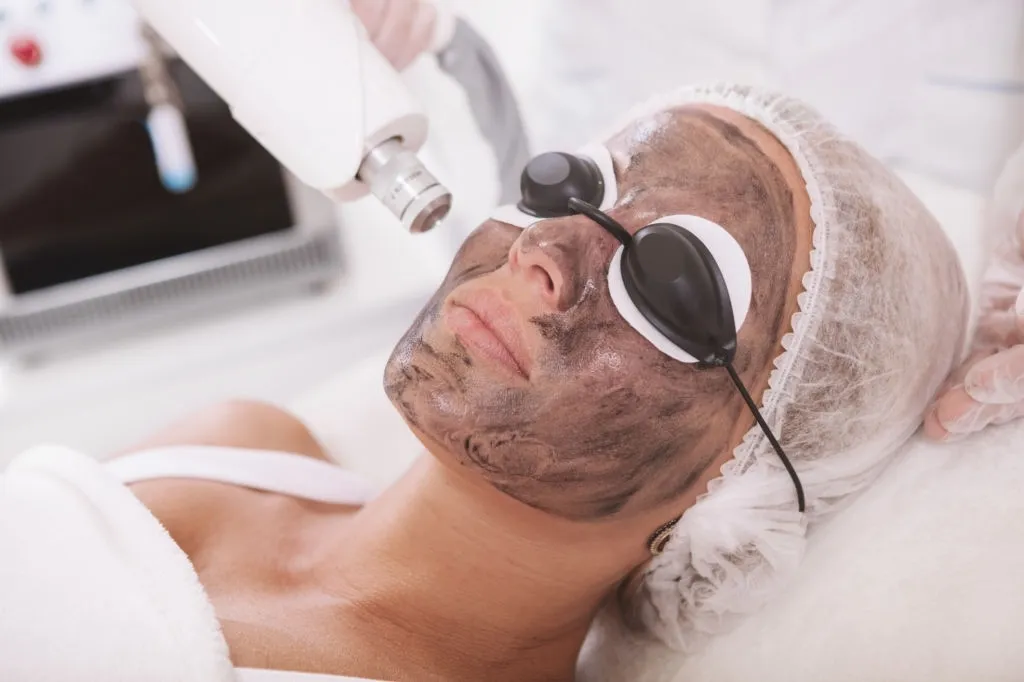
A carbon peel can address several problems in the same session:
- Active acne and acne scars
- Uneven skin tone and pigment spots
- Excess oiliness
- Enlarged pores
- Loss of elasticity and fine wrinkles
Depending on your needs, we plan 5 to 10 sessions 7 to 14 days apart. A brighter look may be noticed after the first session, and the effect becomes clearer as the sessions continue. You do not need to take time off from daily life. We can also carry out this treatment in summer; during this period you need to use sunscreen every day. Peeling the skin with acids is a separate treatment, known as a chemical peel.
Who Is Laser Hair Lightening Suitable For?
Hair lightening is an option for hairs too fine and pale for a conventional hair removal laser to treat. It is used on the soft, downy hair of the face and arms and can be done in any season. For dark, coarse hair, laser hair removal is the more suitable method.
Straight after treatment the hairs turn white, and they shed within a week or two. Depending on the hair type, regrowth takes 1 to 3 months. The hairs that grow back do not become thicker or darker; with repeated treatments the hair may become sparser.
How Is Pigmentation Treatment with a Q-Switched Laser Planned?
The first step in laser treatment for pigmentation is to identify the type of spot at an examination. Sharply defined sun spots, called lentigines, can fade in one or a few sessions. Freckles can also be treated, but they tend to darken again with sun exposure.
Melasma, on the other hand, is a type of pigmentation linked to hormones, genetic tendency and sun, and it tends to come back. For melasma we do not use the laser on its own but in low-energy sessions combined with sun protection and topical creams; in this case 6 to 8 sessions 1 to 2 weeks apart may be planned. You can find all the options for each type of pigmentation under pigmentation treatment.
What Should I Be Careful About After Q-Switched Laser Treatment?
After pigment and hair lightening treatments there is mild redness, which usually settles within a few hours; some spots peel lightly. You need to protect the treated area from the sun for at least a few weeks. On sun-exposed skin, or with treatment at the wrong energy, temporary lightening or darkening of the skin can develop; this is why we set the energy to suit your skin type.
Tattoo Removal in Denizli: Your First Q-Switched Laser Consultation
At the first consultation in Denizli we look at the colour, age and location of your tattoo, the type of your pigmentation or the structure of your hair. With this information we discuss how many sessions may be needed and what you can expect from the result. To see Spec. Dr. Tuba Çelebi Kayhan, you can reach us by phone.
Frequently asked questions
Can a laser remove a tattoo completely?
Can permanent make-up and eyebrow tattoos be removed with a laser?
Can I go back to work after a carbon peel?
Can laser hair lightening replace laser hair removal?
Does Q-switched laser treatment hurt?
How many sessions does tattoo removal take in Denizli?
Sources
- Nd:YAG laser treatment — DermNet
- Lentigo — DermNet
- Melasma — DermNet
This page is for general information only and does not replace an examination, diagnosis or treatment. Please consult your doctor for advice about your own situation.